“`html
The 30% Hit You’ll Take If You Withdraw Now
I spent two years managing retirement accounts before I understood how brutal early IRA withdrawals actually are. Most people don’t. They see their rollover IRA balance and think, “I can just pull $10,000 out.” Then the tax bill arrives.
Here’s the math nobody wants to see. You withdraw $10,000 from a rollover IRA before age 59½. The IRS immediately withholds 20% right off the top — that’s $2,000 gone before it hits your account. Then, because you’re under 59½, you owe a 10% early withdrawal penalty on the full $10,000, which adds another $1,000. Depending on your state (let’s use 5% state income tax as a realistic baseline), you’re looking at $500 more. Total damage: $3,500 in taxes and penalties on a $10,000 withdrawal.
The critical thing I missed early on: rollover IRAs and traditional IRAs face the exact same 10% penalty structure if you’re under 59½. That’s not where they differ. The difference — and it’s meaningful — comes in timing and the 60-day window, which I’m covering next. But first, understand this: the 20% withholding + 10% penalty + state tax isn’t negotiable if you actually keep the money out.
One more detail that surprises people. The IRS counts calendar days, not business days. If you withdraw on a Friday, that’s Day 1. The clock doesn’t restart on Monday. This matters enormously when you’re racing against the 60-day deadline.
The 60-Day Rollover Rule That Saves You Everything
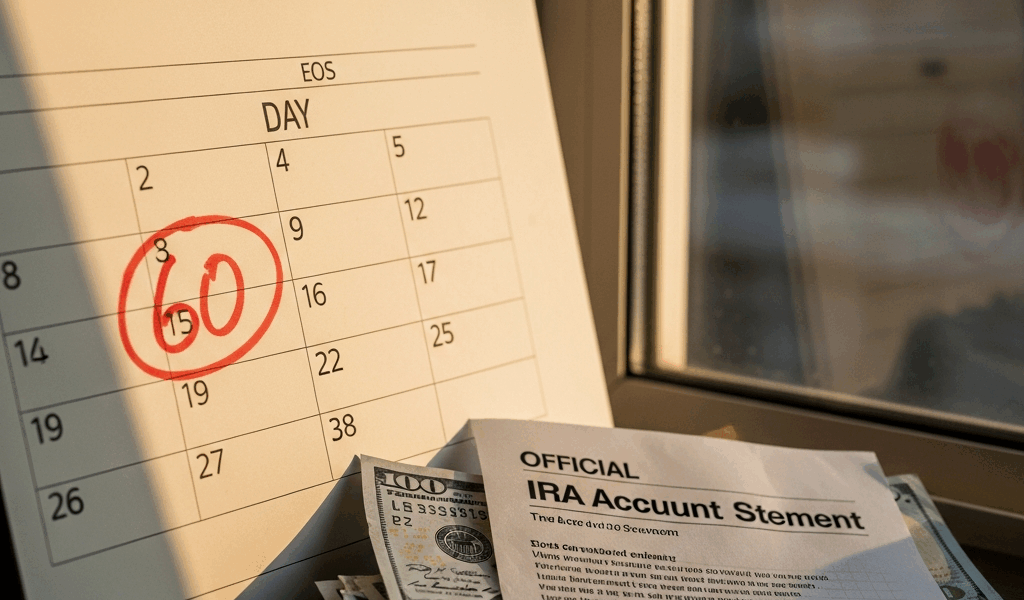
This is the rule that changes everything. You can withdraw money from a rollover IRA, hold it for up to 60 calendar days, and deposit it back into any IRA — a different institution, a different account type, doesn’t matter — and owe zero in taxes or penalties. Zero.
Let me give you the exact scenario that works. On January 1st, you withdraw $10,000 from your rollover IRA at Fidelity. You need the cash for an emergency. You don’t touch the money. On March 1st (Day 60), you deposit all $10,000 into a rollover IRA at Vanguard. The IRS sees this as a valid rollover. You file your taxes. You owe nothing. No 10% penalty. No income tax on the withdrawal. Nothing.
Probably should have opened with this section, honestly. This rule is the entire reason someone in a real financial emergency might choose a rollover IRA over other retirement accounts.
The IRS enforces one critical boundary: you can use this 60-day rollover only once every 12 months across all your IRAs combined. Not once per account — once total. If you withdraw from a rollover IRA in January and use the 60-day window, you cannot use it again until January of the next year, even if you have three other IRAs sitting there. Miss that rule, and the second withdrawal is taxable immediately.
Another detail that catches people off-guard: the 60 days is firm. The IRS offers no extensions. There’s a 2014 Supreme Court case (Bobrow v. Commissioner) that made this abundantly clear. A taxpayer missed the deadline by one day and lost the ability to roll over. The Court ruled the IRS can enforce the deadline strictly. No exceptions for mail delays, no grace periods for circumstances.
Here’s what that $10,000 scenario actually looks like with the 60-day rule in play: You withdraw. The custodian withholds $2,000 (20% withholding). You receive $8,000 in your bank account. You have 60 days to deposit $10,000 back into an IRA. This is the catch — you need to come up with the $2,000 that was withheld from another source (your paycheck, savings, elsewhere) to deposit the full amount. If you only redeposit $8,000, the $2,000 is treated as a taxable distribution, and you owe taxes on it. The full mechanics matter.
Why Rollover IRAs and Traditional IRAs Differ at Withdrawal Time
Both account types face the same 10% early withdrawal penalty if you’re under 59½. That’s not their distinction.
The real difference emerges in flexibility after age 59½ and in Required Minimum Distribution (RMD) rules. A rollover IRA doesn’t trigger RMDs until age 73, and even then, the calculation is slightly more favorable because rollover IRAs (typically SEP or SIMPLE IRAs that have been rolled over) often have lower year-one RMD percentages. A traditional IRA, once you hit 73, forces RMDs based on your life expectancy. If you don’t need the money, a rollover IRA gives you breathing room.
For someone aged 62 with a rollover IRA who needs emergency cash, you can withdraw penalty-free because you’ve passed 59½. Same age with a traditional IRA? Also penalty-free. The gap between them doesn’t exist at that age. The 60-day rule is available to both equally.
Where a rollover IRA wins for someone in genuine financial distress under age 59½: the 60-day window is your lifeline. You use it, you avoid the penalty entirely. A traditional IRA gives you the same 60-day window, so they’re equivalent on that front. But if you’re 55 and already separated from service (the “Rule of 55” exception), you can withdraw from a traditional IRA penalty-free if the withdrawal is a series of “substantially equal periodic payments.” Rollover IRAs don’t typically qualify for Rule of 55. That’s a scenario where traditional IRAs have the advantage.
Bottom line: for emergency withdrawals under 59½, use the 60-day rollover rule with whichever IRA you have. Both are safe if you follow the calendar. For retirement in your 60s, rollover IRAs are marginally more flexible.
If You Miss the 60-Day Window (What Happens Next)
You didn’t redeposit by Day 60. You have $10,000 sitting in your checking account on Day 61. What now?
The withdrawal becomes permanent and taxable. You owe federal income tax on the full $10,000 at your marginal rate (let’s say you’re in the 22% bracket — that’s $2,200). You owe the 10% early withdrawal penalty if you’re under 59½ ($1,000). You owe state income tax if your state has one (another $500 in our 5% example). Total: $3,700 gone, plus the $2,000 already withheld by your custodian. Effective hit on a $10,000 withdrawal is closer to $5,700.
The IRS will not extend this deadline. There are no hardship exceptions. The Supreme Court made that clear. Your only option after Day 60 is to file taxes and pay what you owe.
One potential workaround for future withdrawals (though not for the current one): a Roth conversion. If you have access to a traditional IRA and you convert portions of it to a Roth IRA, you can withdraw contributions (not earnings) from the Roth penalty-free after a 5-year holding period. This doesn’t solve your immediate problem, but it’s worth understanding for the next cycle.
Three Scenarios: When to Withdraw from Each
Scenario 1: Emergency, age 45, under 59½
Use your rollover IRA if you have one. Withdraw what you need. You have 60 calendar days to redeposit every penny. Set a phone reminder for Day 59. If you make the deadline, you owe zero in taxes and penalties. If you miss it, you’re looking at a $3,000+ bill on a $10,000 withdrawal. A traditional IRA works identically here — the 60-day rule applies to both. Choose whichever account has the cash available.
Scenario 2: Early retirement, age 62, no penalties apply
At 62, you’ve passed 59½. Neither account penalizes you for early withdrawal. The 60-day rule is irrelevant because there’s no tax consequence anyway. Draw from whichever account has the lower fees or better fund selection. If you need ongoing income, a rollover IRA is slightly better because RMD pressure doesn’t hit until 73, giving you a longer runway before forced withdrawals.
Scenario 3: Age 75, forced RMDs looming
You’re past 73. RMDs are mandatory from both accounts. A traditional IRA forces specific withdrawal amounts based on your age and account balance. A rollover IRA (if it’s a SEP or SIMPLE that was rolled over) typically allows more flexibility in how RMDs are calculated. If you’ve been managing your accounts well and don’t need the full RMD, a rollover IRA is the safer choice because you have slightly more control over which withdrawal strategy to use. This is a minor advantage, but it compounds over time.
“`




Stay in the loop
Get the latest wealth rollover updates delivered to your inbox.