
Fidelity vs Schwab at a Glance
| Feature | Fidelity | Charles Schwab |
|---|---|---|
| Account Minimum | $0 | $0 |
| Stock & ETF Commissions | $0 | $0 |
| Proprietary Index Fund Expense Ratio | 0.00% (FZROX) | 0.03% (SWTSX) |
| Fractional Shares | Yes — stocks & ETFs | Yes — stocks only via Schwab Stock Slices |
| Robo-Advisor Option | Fidelity Go ($0 under $25K) | Schwab Intelligent Portfolios ($5,000 min) |
| Customer Support | 24/7 phone, chat, 200+ branches | 24/7 phone, chat, 300+ branches |
Choosing between these two has started getting harder to follow with all the “they’re basically the same broker” noise flying around. They’re not. Fidelity is the stronger pick for cost-obsessed beginners who want a clean, guided experience without decoding a trading terminal. Schwab is genuinely solid — bigger branch footprint, good research tools — but it quietly asks more from someone who has never invested outside a company 401(k).
Fees and Minimums — What You Actually Pay
Both brokers advertise zero-commission trades. That’s true. But commissions aren’t where the real cost gap lives for a beginner — expense ratios are. Here’s the number that actually matters: Fidelity’s FZROX, the Fidelity ZERO Total Market Index Fund, carries a 0.00% expense ratio. Not rounded down. Literally zero. On a $10,000 investment, you pay nothing in annual fund fees. Nothing. Schwab’s closest equivalent, SWTSX, charges 0.03% — that’s $3 a year on the same $10,000. Not a dealbreaker on its own. But FZROX being genuinely free isn’t a marketing trick, and that gap compounds quietly over a 30-year retirement horizon.
Neither broker charges account maintenance fees or inactivity fees. No minimum balance to open a taxable brokerage account or a rollover IRA. That symmetry matters — beginners often assume they need a certain threshold just to get started. They don’t.
One genuine Schwab friction point worth flagging: Schwab Intelligent Portfolios, their robo-advisor, requires $5,000 to start. Fidelity Go has no minimum and charges nothing until your balance crosses $25,000, at which point it’s 0.35% annually. Starting with under $25K and want a managed account? Fidelity Go is the cheaper on-ramp — by a lot.
Bottom line: Fidelity wins on fees, mostly on the strength of its ZERO fund lineup and the no-minimum robo option.
Ease of Use for First-Time Investors
Worth flagging before going further — because for a true beginner, the experience matters far more than a 0.03% expense ratio difference.
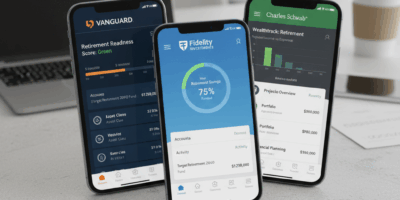
Fidelity’s mobile app has gone through a real redesign over the last two years. It’s cleaner. Setting up automatic monthly contributions takes about four taps from the home screen once your account is funded. I walked a 58-year-old first-time investor through the account-opening process over the phone — she was done in under 12 minutes, including identity verification. That was on a weeknight, no branch visit required.
Schwab’s app is functional and well-reviewed. But it defaults to a layout that reads more like a trading dashboard than a beginner’s savings tool — more panels, more data points, more options visible before you’ve placed a single trade. For a seasoned investor, that’s a feature. For someone who has never invested outside a company 401(k), it just looks like noise.
Robo-Advisor Comparison — and the Schwab Cash Drag Problem
Want to hand your money to an algorithm and not think about it? Both brokers offer that. But Schwab Intelligent Portfolios has a documented issue worth naming directly: cash drag.
Schwab’s robo product holds a chunk of your portfolio in cash — typically 6% to 10% depending on your risk profile — parked in a Schwab bank account earning below-market rates. On a $20,000 rollover, that’s $1,200 to $2,000 sitting idle while the market does its thing. It’s not hidden exactly — but it’s buried, and most beginners don’t notice it until they compare returns side by side with a friend on a different platform. Learn from what tripped me up of glossing over that fine print.
Fidelity Go invests everything. No cash drag. For someone who just wants simple, low-cost managed investing, that difference is real.
Ease of use verdict: Fidelity.
Rollover IRA Experience — Which Makes It Easier
This is the section that matters most if you’re sitting on a 401(k) from an old job and trying to figure out what to do with it.
Fidelity handles rollovers well. Their online rollover center walks you through it step by step — and if your old 401(k) is at a major provider, Fidelity can often initiate the transfer directly without you ever calling your old plan administrator. Average direct rollover transfer time: 3 to 5 business days. Indirect rollovers, where a check gets mailed to you, carry that stressful 60-day deadline. But that’s true everywhere.
Schwab also offers rollover support and assigns dedicated rollover specialists reachable by phone. Their branch network — over 300 locations across the U.S. — is a genuine advantage for anyone who wants to sit across from a human being and have the paperwork explained face to face. If that’s you, Schwab’s physical presence is a legitimate reason to choose it.
I’m apparently someone who panics about financial paperwork, and Fidelity’s self-service rollover tool works for me while the “wait for a specialist callback” approach never quite did. Burned once by assuming a check mailed to me was fine — then spending a frantic week confirming I hadn’t missed the 60-day window — I now tell everyone: go direct. Both brokers support direct rollovers. Both have 24/7 phone support. The process friction is roughly equivalent. But Fidelity’s online tool means you don’t have to call anyone if you don’t want to. For someone rolling over a mid-five-figure balance at 11pm on a Tuesday, that matters more than it sounds.
The Verdict — Which Broker Should You Pick
No hedging. Real answers for specific situations.
- Best for lowest cost — Fidelity. The ZERO fund lineup — FZROX, FZILX — has no true equivalent at Schwab.
- Best for beginner experience — Fidelity. Cleaner app, less overwhelming default layout, no-minimum robo-advisor with no cash drag.
- Best for rollover IRA — Fidelity, narrowly. The self-service rollover tool and fast direct-transfer process give it the edge for anyone who wants to handle things themselves.
- Best for human support and in-person help — Schwab. More branches, dedicated rollover reps, strong phone service reputation. Want to walk into an office? Schwab wins that one.
Fidelity takes three of those four categories. That makes it the right default for most first-time investors and rollover newcomers. Schwab isn’t a bad broker — it’s genuinely good — but it quietly asks more from you upfront, and beginners shouldn’t have to work that hard just to get started.
If you already know you want a rollover IRA specifically, the comparison doesn’t shift much — Fidelity is still the easier path. But if you want a deeper look at how these two handle retirement accounts head-to-head, the Fidelity Rollover IRA vs Schwab breakdown gets into the account-specific details. And if you’re still weighing Vanguard as a third option, the Fidelity vs Vanguard and Vanguard vs Schwab pieces round out the full picture.



Stay in the loop
Get the latest wealth rollover updates delivered to your inbox.