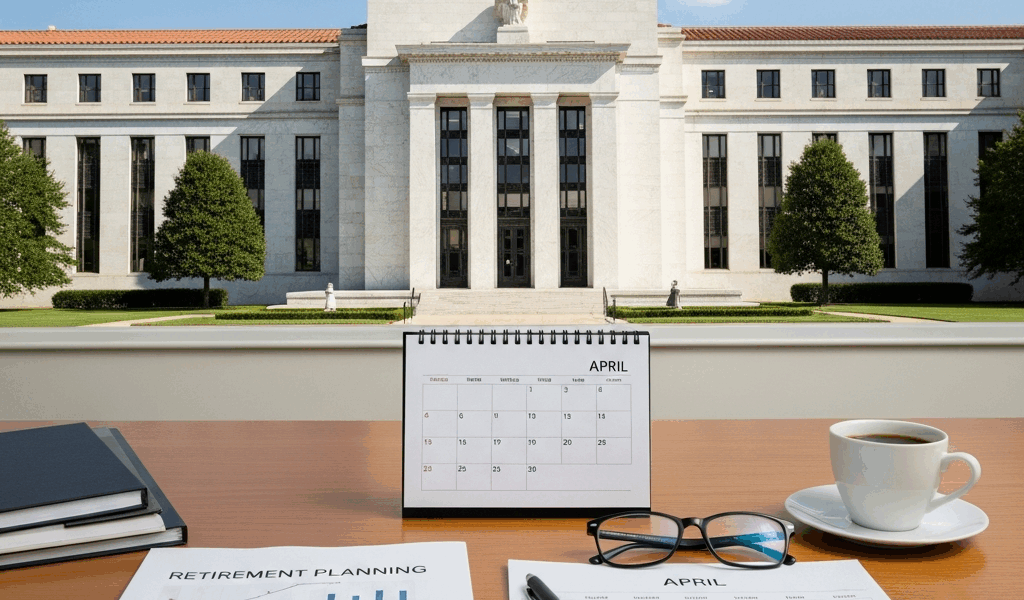
The Federal Reserve is almost certain to leave its benchmark interest rate unchanged when the Federal Open Market Committee wraps up its two-day meeting on April 29, 2026. That meeting could also quietly mark the end of Jerome Powell’s tenure as the most powerful central banker in the world.
Markets are pricing in a 94% probability of a hold, according to CME FedWatch data. The federal funds rate sits at 3.50%–3.75% — where it has been since the Fed’s last move — with the reserve balance rate at 3.65%. No cut is expected. J.P. Morgan’s base case puts the next move as far out as Q3 2027, and when it comes, it could be a hike, not a cut.
Why This Meeting Feels Different
Five days before the FOMC convened, something shifted. On Friday, April 24, U.S. Attorney Jeanine Pirro announced the Justice Department was dropping its criminal investigation into Powell — a probe centered on cost overruns at the Fed’s headquarters renovation project, where the original $1.9 billion estimate had ballooned to roughly $2.5 billion. Pirro’s office said it was redirecting the matter to the Fed’s Inspector General while making clear it would “not hesitate to restart a criminal investigation should the facts warrant doing so.” Notably, the DOJ announcement did not extend to a parallel investigation into Fed Governor Lisa Cook, which remained open — a distinction Sen. Elizabeth Warren made explicit in her public response to the announcement.
The timing wasn’t coincidental. Sen. Thom Tillis (R-NC) had been the decisive “no” vote blocking Trump’s Fed chair nominee Kevin Warsh in the Senate Banking Committee — a panel with 13 Republicans and 11 Democrats — calling the DOJ probe “frivolous” and making its termination a condition of his support for Warsh. With Tillis’s defection over the investigation’s existence, Republicans were deadlocked at 12. No majority existed to advance Warsh. The probe’s suspension may have changed that math entirely.
“This morning the Inspector General for the Federal Reserve has been asked to scrutinize the building cost overruns — in the billions of dollars — that have been borne by taxpayers. Accordingly, I have directed my office to close our investigation as the IG undertakes this inquiry.”
— U.S. Attorney Jeanine Pirro, April 24, 2026
Powell’s term as Fed chair expires May 15, 2026. If Warsh isn’t confirmed by then, Powell has said he intends to serve as chair pro tempore — his own characterization of how he would handle the interim period, rather than a defined institutional procedure — though he has also said he has no intention of leaving the Fed’s Board of Governors until matters are resolved “with transparency and finality.” His governor’s term runs through January 2028.
Who Is Kevin Warsh — and What Does He Mean for Rates
Warsh served on the Fed’s Board of Governors from 2006 to 2011, earning a reputation as a hawk. He has since signaled support for rate cuts, arguing that AI-driven productivity gains could help suppress inflation — a pivot notable enough to leave markets genuinely uncertain about where he’d actually take policy.
“The two big questions are who’s the real Kevin Warsh and does that evolve?”
— Michael Feroli, Chief U.S. Economist, JPMorgan Chase
Deutsche Bank analysts aren’t buying the dovish framing: “Although Warsh has argued for lower rates, we do not view him as structurally dovish. Instead, his views have tended to skew hawkish relative to others.” BlackRock’s base case lands somewhere in the middle — a new chair who eventually cuts rates one or two times, pulling the overnight rate toward the 3.00%–3.25% range.
At his Senate Banking Committee hearing on April 21, Warsh committed to Fed independence and staying out of fiscal and social policy — the kind of language aimed directly at moderates nervous about White House influence over monetary decisions.
“Monetary policy independence is essential. Monetary policymakers must act in the nation’s interest, their decisions the product of analytic rigor, meaningful deliberation, and unclouded decision-making.”
— Kevin Warsh, prepared Senate remarks, April 21, 2026
What This Means for Retirees Holding Cash and Bonds
For retirees relying on fixed income in IRAs and 401(k)s, the hold is the good news. The uncertainty around what comes next is the complication. With rates still at 3.50%–3.75%, the best high-yield savings accounts are paying up to 5.00% APY and top CD rates remain near 4.20%, per April 21 data. U.S. inflation most recently came in at a 3.3% annual rate — the highest in nearly two years — meaning those yields still exceed inflation in nominal terms, a condition that hasn’t held consistently for most of the past decade.
A leadership transition at the Fed would be the most significant variable for bond holders in years. Schwab and LPL Research both see the 10-year Treasury yield holding in the 3.75%–4.25% range for 2026, but note that a more dovish Fed posture post-Powell could pull that range lower. Bond prices move inversely to yields — so a rate-cut cycle, whenever it arrives, would support existing bond positions. A surprise pivot toward tighter policy under Warsh would cut the other way.
All FDIC-insured deposit accounts remain protected up to $250,000 per institution, whatever happens at the Fed.
What to Watch Between Now and May 15
The April 29 rate decision is a foregone conclusion. The real event risk is the Senate confirmation vote on Warsh — specifically whether it clears before Powell’s chair term expires on May 15. Watch for Tillis to signal publicly whether the DOJ probe suspension satisfies his condition. That announcement could come within days. If Warsh is confirmed before the deadline, expect markets to immediately begin repricing rate-cut expectations based on whatever signals he sends in his first public remarks as chair-designate.

Stay in the loop
Get the latest wealth rollover updates delivered to your inbox.