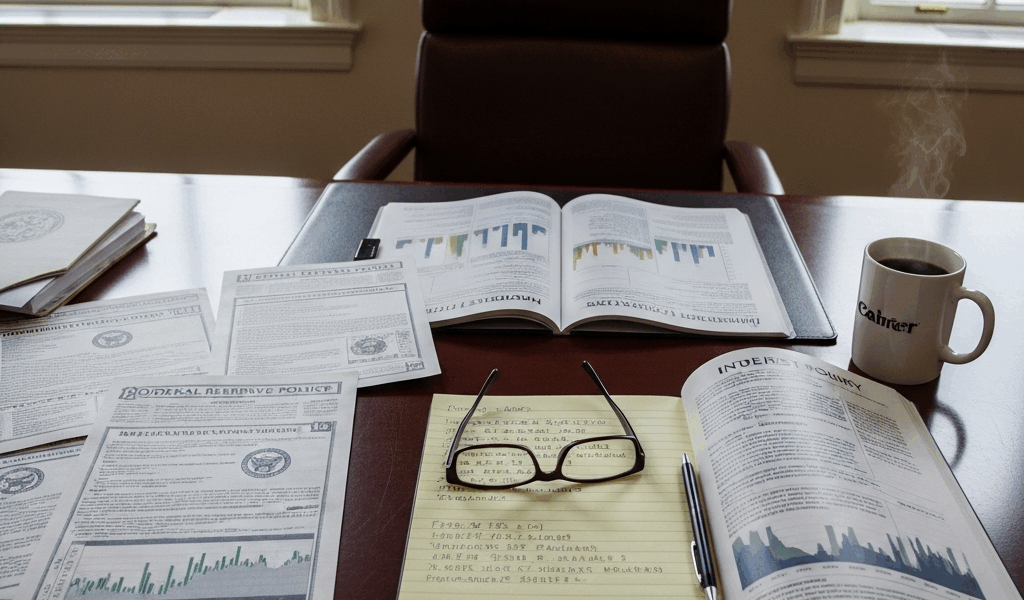
The Federal Reserve held its benchmark interest rate steady at 3.5%–3.75% on April 29 — the third consecutive meeting without a move — but the rate decision itself was almost beside the point. The vote split 8-4, the first four-dissenter split at an FOMC meeting since October 1992. And Jerome Powell used his final press conference as Fed Chair to announce he will remain on the Fed board as a governor rather than retire.
The Vote — and What the Dissents Actually Mean
Four officials broke from the majority. They didn’t all break in the same direction.
Governor Stephen Miran voted to cut rates by 25 basis points. That’s the dovish side. On the other end, Cleveland Fed President Beth Hammack, Minneapolis Fed President Neel Kashkari, and Dallas Fed President Lorie Logan voted against new statement language suggesting future cuts could be forthcoming — not for a hike, but against the phrasing itself. The sentence that set them off: “In considering the extent and timing of additional adjustments to the target range for the federal funds rate…” The hawkish three viewed that language as premature at this meeting given current conditions.
Inflation is the reason the Fed is frozen. CPI came in at 3.3% in March. Core inflation is running at 3.2%, and economists now forecast April’s reading could jump to 3.9% annually as energy prices surge — gasoline hit $4.23 per gallon Wednesday, roughly $1.25 above pre-conflict levels — following the Iran war that began February 28. The FOMC’s official statement reflected that reality, dropping “somewhat elevated” in favor of flatly calling inflation “elevated, in part reflecting the recent increase in global energy prices.”
“We’re in an unusually difficult situation. We’ve had four supply shocks — the pandemic, the invasion of Ukraine, the tariffs and now Iran and the oil spike. Every supply shock has the capability of driving inflation up and unemployment up.” — Jerome Powell, April 29, 2026
Powell also said “nobody is calling for a hike right now” and that the committee “feels we’re in a good place to move in either direction.” Traders weren’t fully convinced. CME FedWatch briefly showed a 9.1% probability of a rate increase by December, compared to 0% the day before.
Powell Stays — and Why It Matters for the Next Chair
Powell’s chairmanship expires May 15, 2026. He had planned to retire from the board entirely. He’s not retiring.
Instead, Powell announced he will remain on the Fed board as a governor — a seat that runs through January 2028 — citing ongoing legal actions against him as the reason he changed course.
“I’m literally staying because of the actions that have been taken. I had long planned to be retiring. And the things that have happened in the last three months, they have left me no choice but to stay until I see them through.” — Jerome Powell, April 29, 2026
He was equally direct about what that role won’t be: “I plan to keep a low profile as a governor. There’s only ever one chair. When Kevin Warsh is confirmed and sworn in, he will be that chair.”
That transition is moving fast. The Senate Banking Committee advanced Warsh’s nomination on a 13-11 party-line vote — the first fully partisan Fed chair committee vote in history, according to Senator Elizabeth Warren. A full Senate floor vote is expected the week of May 11, which would put Warsh in the chair seat before Powell’s term technically expires. His first FOMC meeting as Chair is projected for June 16–17.
There’s a structural wrinkle worth noting. Because Powell is staying on the board rather than vacating his governor seat, Warsh will inherit Miran’s seat — not Powell’s. As ClearBridge analyst Josh Jamner pointed out, “the addition of Kevin Warsh to the FOMC will not swing the balance between doves and hawks” in the way some had anticipated.
What This Means for Savers Right Now
The prime rate stays at 6.75%. Credit cards, HELOCs, and adjustable-rate debt remain expensive. High-yield savings accounts and CDs are still offering rates above 4% APY at many online banks — above the current inflation rate — but that window is getting smaller. Ally Financial moved first, trimming deposit rates the week prior, and Capital One, Synchrony, and Marcus by Goldman Sachs have since followed with quiet reductions of their own — and no Fed cut has happened yet. Wall Street futures pricing now pushes the first expected cut into 2027.
Near-retirees with cash in money market funds or short-term CDs should be aware: when a cut eventually comes, deposit yields will compress within weeks. Locking in longer-duration CDs at current rates is a decision worth revisiting now, not after the June meeting.
What to Watch Next
The week of May 11 is the critical window — Senate floor vote on Warsh, Powell’s final day as Chair on May 15, and April CPI data that will show whether the energy spike pushed inflation toward that 3.9% forecast. The June 16–17 FOMC meeting, Warsh’s first if confirmed, is now where the market is looking for any real signal on where rates go from here.



Stay in the loop
Get the latest wealth rollover updates delivered to your inbox.